

Yamaha service
The Yamaha maintenance schedule, explained
What actually happens to your outboard at every interval, and what goes wrong when one gets skipped. Written by the technicians who do the work, not copied off a brochure.
Every 2 years · or 200 hours
Yamaha VST service
- Every 2 years
- Both filters, the lid gasket
- Fuel cooler stripped and cleaned



Our own film: what the tank does, how the filters and the cooler silt up, and why we would rather replace them than replace a pump.
A high-pressure fuel pump failure is one of the few things that will actually stop a Yamaha while you are out on the water. We started doing this service after two seasons of a high failure rate on those pumps, and the cause turned out to be something a shallow, sandy bay does to a cooling passage.
What the VST is
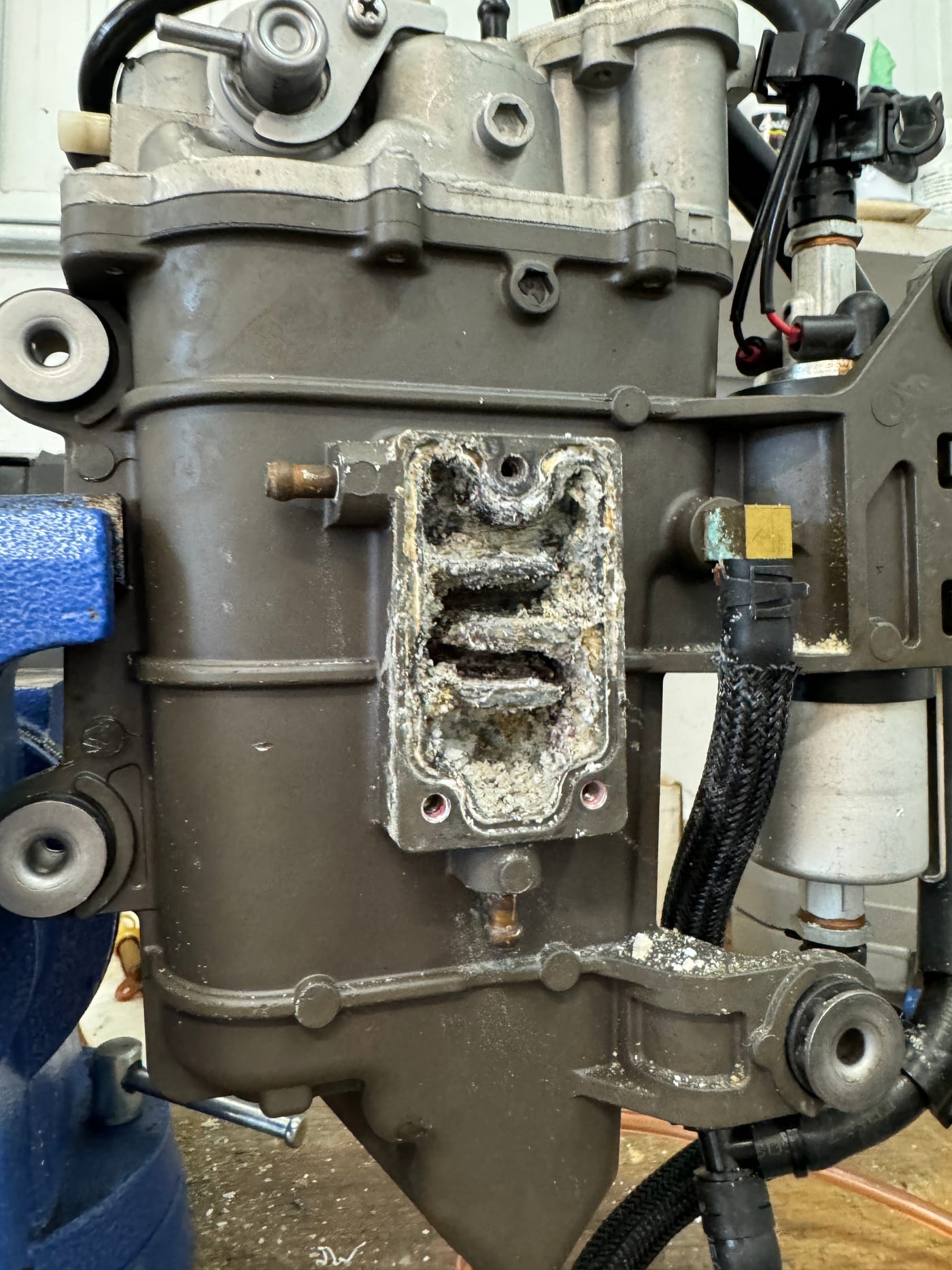
The vapor separator tank lives under the intake manifold. Inside it are a filter and the high-pressure fuel pump, with a second filter on top. On the backside is the fuel cooler, and a cooling passage runs through it.
The pump is cooled by the fuel it sits in. The fuel is cooled by that passage. That is the whole chain, and it has one weak link.
Why it matters here in particular
That passage clogs easily, with corrosion or with sand. We run in shallow bays, and sand moves through everything that takes raw water. The fuel cooler is a narrow passage at the back of a tank nobody ever looks at, so it silts up quietly.
Nothing on the gauge says so. The first symptom most owners get is an engine that will not restart in the afternoon — and by then the pump is done. All the signs of a failing fuel pump →
What we do
- Remove the intake manifold. There is no shortcut to the tank; it is underneath.
- Remove the vapor separator tank.
- Disassemble the tank. Both filters replaced, the one inside and the one on top, and the lid gasket replaced so it seals properly going back together.
- Disassemble the fuel cooler on the backside. Cleaned out completely, not flushed and hoped over. New gaskets, reassembled, refitted.
Keeping water moving through those passages keeps the tank cool. A cool tank keeps the fuel around the pump cool. A cool pump does not fail early. That is the entire point of the service, and it is why we would rather do it on a bench in the winter than on a call.
When to have it done
Our schedule puts it at every 2 years, and that is what the shop works to on every Yamaha that comes through. It sits on the same line as spark plugs and anodes on the full maintenance schedule.
Where a boat runs matters on top of that. One that lives in skinny water earns it sooner than one running out of a deep marina, so we will tell you where yours stands when it is in for its 100-hour service or its winterization.
How it's quoted
We quote it the same day you ask. The number depends on your engine, and the service writer confirms it with you before any work begins.
Yamaha Marine Service Pro Elite dealer in Selbyville — five certified technicians, one of them a Master Tech. 💬 Ask the assistant or call (302) 436-1737.
The rest of the schedule
We are in Selbyville, Delaware, and we cover the Delmarva Peninsula — Ocean City and Ocean Pines in Maryland, Fenwick Island, Bethany Beach, Ocean View, Millsboro, Rehoboth and Lewes in Delaware. Keeping you on the water is the whole job.
From the shop floor
Zak Smith, Yamaha Master Technician, on this.